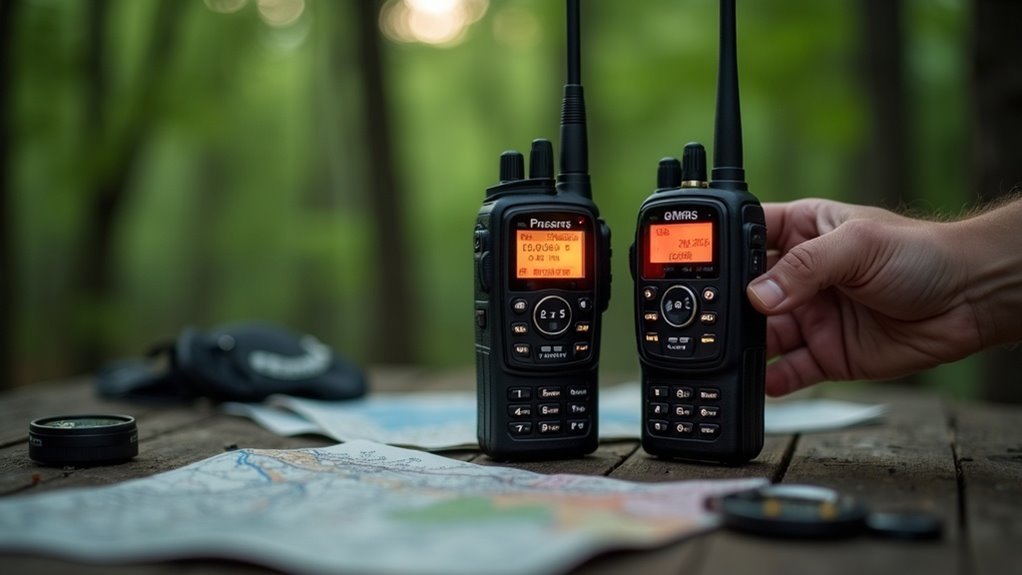
To use FRS and GMRS radios effectively for survivalism and prepping, first, understand the licensing requirements—GMRS requires a $35 license, while FRS does not. Choose the appropriate equipment; GMRS radios provide an extended range, which can be crucial in emergency situations. Program your radios by selecting the desired frequency and setting privacy tones to ensure secure communication with your group.
Practice good radio etiquette: always announce your call sign, listen before speaking to avoid overlapping conversations, and use clear, concise language to convey important information. Troubleshoot common issues such as incorrect channel settings or physical obstructions that may hinder communication. For enhanced range and reliability, consider using repeaters to extend your communication capabilities in challenging environments. Stay informed and prepared with more insights on optimizing your radio experience for survival situations!
Key Takeaways
- Choose GMRS radios for extended range and higher power, making them ideal for survival situations; FRS radios can be useful for casual communication without the need for a license.
- Ensure all radios are set to the same channel and privacy codes to facilitate clear communication during emergencies.
- Announce your FCC call sign at the beginning and end of transmissions to maintain accountability and ensure proper identification in critical situations.
- Practice good communication etiquette by listening before transmitting and allowing breaks between messages to avoid interference and ensure clarity.
- Familiarize yourself with radio settings and conduct regular tests on devices to ensure they are functional and compatible, which is essential for effective communication in preparedness scenarios.
Understanding GMRS and FRS Licensing
When considering the use of GMRS or FRS radios for survivalism and prepping, it’s crucial to understand the licensing requirements for each service.
A GMRS license is mandatory for transmitting on GMRS frequencies, costing $35 and valid for ten years, which covers your immediate family. This can be particularly beneficial in emergency situations where reliable communication is vital.
A GMRS license, costing $35 for ten years, is essential for effective emergency communication with your family.
In contrast, FRS radios don’t require a license, making them easily accessible for casual use or for those just starting their prepping journey.
While GMRS radios can operate at higher power levels (up to 50 watts), providing a greater range for communication during critical times, FRS radios are limited to 2 watts, which can restrict their effectiveness in expansive outdoor settings.
The application process for a GMRS license is straightforward, with approvals often occurring within just a few days, allowing you to quickly set up your communication plan in line with FCC rules.
Understanding these distinctions can greatly enhance your preparedness strategy.
Choosing the Right Equipment for GMRS and FRS
Choosing the right equipment for GMRS and FRS radios is crucial for effective communication in survival and prepping situations. When selecting handheld radios, keep in mind that GMRS radios can transmit at higher power levels, providing an extended range compared to FRS options, which is vital during emergencies or outdoor expeditions.
Remember, GMRS requires an FCC license, while FRS does not, making FRS a more accessible choice for casual users or those just starting their prepping journey.
For optimal compatibility, opt for GMRS radios that can operate on both GMRS and FRS frequencies. Look for features such as tone squelch and privacy codes to filter out unwanted transmissions, ensuring that your communications remain secure and clear.
Additionally, consider mobile GMRS units or external antennas to enhance your communication capabilities, as reliable communication can be a critical factor in survival scenarios.
Essential Communication Etiquette for Radio Use
Effective communication etiquette is crucial for maximizing the utility of GMRS and FRS radios, especially in survival and prepping scenarios where clear communication can be vital.
To enhance your radio communication in these situations, follow these guidelines:
- Always announce your call sign at the beginning and end of transmissions to identify yourself and maintain accountability.
- Listen before transmitting to check if the channel is in use, ensuring that you don’t interrupt essential communications.
- Use clear, concise language to convey important information quickly and avoid unnecessary chatter that can lead to confusion.
- If using privacy tones, ensure all parties involved in your group have the same tone set to maintain secure communication.
- Be respectful by allowing breaks between transmissions and not monopolizing the frequency, which allows others to share critical information when needed.
Programming Your GMRS and FRS Radios
Programming your GMRS and FRS radios is an essential skill for survivalists and preppers, as effective communication can be critical in emergency situations. While it may seem daunting at first, mastering the basic steps can greatly enhance your preparedness.
Begin by selecting your desired channel; many GMRS radios come pre-programmed with the 22 shared channels of FRS, enabling immediate communication when needed.
If you want to maintain privacy in your communications, consider configuring privacy tones (CTCSS/DCS) to filter out unwanted transmissions. For GMRS radios, adjusting the SEND-only or SEND/RECEIVE tone settings can further enhance your communication security.
Additionally, remember to access repeater channels using offset programming, typically +5.0 MHz for GMRS, which can extend your communication range.
It’s crucial to regularly check and synchronize settings across different radio models to ensure clear communication and to minimize compatibility issues in the field.
Being well-prepared with your radio equipment can significantly improve your chances of staying connected during critical situations.
Troubleshooting Common Communication Issues
When troubleshooting communication issues with your FRS and GMRS radios during a survival situation, start by checking your channel settings to ensure both devices are aligned.
Next, verify that any privacy codes aren’t blocking your signals, as disabling them can enhance clarity in critical moments.
Additionally, consider potential obstructions in your environment, such as trees or buildings, that might be affecting signal strength.
Adjust your location as needed for optimal reception to ensure effective communication when it matters most.
Channel Selection Problems
Channel selection problems can significantly impact communication during critical survival situations when using FRS and GMRS radios.
To ensure effective communication in the field, follow these troubleshooting steps:
- Always listen before transmitting to minimize interference and ensure clarity.
- Confirm that both radios are set to the same channel to facilitate seamless communication.
- Check for conflicting privacy tones that might obstruct vital exchanges of information.
- Ensure proper radio settings by disabling unnecessary privacy codes that could complicate communication.
- Review channel designations, particularly distinguishing between simplex and repeater communication for optimal usage in emergency scenarios.
Privacy Code Conflicts
Privacy code conflicts can pose significant challenges for effective communication among survivalists using FRS and GMRS radios, particularly in group scenarios.
To ensure seamless communication during critical situations, it’s essential to confirm that all radios are configured to the same channel and tone squelch settings. If you encounter difficulties in hearing one another, double-check that privacy codes aren’t activated, as these can obstruct transmissions from users operating on different tones.
Consistently verify your radio settings, especially after switching channels, to avoid miscommunication in high-stakes situations. Establishing a clear protocol for channel and tone settings within your group is crucial to minimize confusion and ensure that everyone can communicate effectively without interference, especially during emergencies when every moment counts.
Signal Obstruction Issues
Signal obstruction can significantly impede effective communication with FRS and GMRS radios, especially in survival situations where clear communication is critical.
To enhance your communication range in challenging environments, consider the following strategies:
- Be aware of natural obstacles like hills, dense forests, and urban structures that can interfere with signals.
- Utilize GMRS repeaters to extend your range in areas with heavy obstruction, ensuring you stay connected with your group.
- Invest in outdoor or elevated antennas to improve signal strength and clarity, which can be essential during emergencies.
- Regularly verify your radio settings to ensure that privacy codes are synchronized among users, preventing unauthorized access to your communications.
- Adjust channels according to your surroundings, as specific frequencies may yield better performance depending on the conditions.
Enhancing Your Range With Repeaters
When you aim to significantly enhance your communication range for survival situations, utilizing GMRS repeaters is a highly effective strategy.
GMRS radios, which operate at higher power levels, can facilitate communication over distances of 40-100 miles or more by leveraging repeaters. These devices receive signals on one frequency and retransmit them on another, greatly expanding your coverage area.
To access a repeater, ensure your GMRS radio is programmed with the correct offset frequency, typically +5.0 MHz.
It’s crucial to consult local repeater directories, such as MyGMRS.com, to locate active repeaters and their operational details, ensuring reliable communication for your preparedness and family safety in emergency scenarios.
Best Practices for Group Communication
Effective communication within a group is vital, especially in survival situations where clarity can make a significant difference.
Here are some best practices to enhance your group’s communication using handheld GMRS radios:
- Always select a clear channel and announce your call sign before speaking to ensure everyone knows who’s communicating.
- Utilize tone squelch settings to filter out unwanted transmissions and maintain focus on essential conversations.
- Listen to the channel before transmitting to avoid interrupting others and ensure the line is clear.
- Provide your FCC callsign at least once every 15 minutes during extended conversations to maintain proper identification and compliance.
- Encourage all users to check their radio settings for compatibility to prevent communication issues within the group.